Yes, it’s that time of year again: who cares if Trump is now President of Venezuela, we have the 158th meeting of the World Health Organisations’ Executive Board to distract us! I dream of the day when its members prance into the Executive Board room at Geneva HQ to the sound of E Zee Possee. I guess we all have our secret fantasies. But until that day, I do what I always like to do in January and write about EB documents that focus specifically on WHO’s program budget. Don’t ask me why – divine punishment for bad things I did in a past life, probably. The Executive Board meeting will run from 2-7 February and you can watch proceedings live via the link above. For this post, I’m going to focus on a classic document – the EB’s biennial ‘out with the old and in with the new’ budget review Financing and implementation of the Programme budget 2024–2025 and outlook on the Programme budget 2026–2027:Report by the Director-General or EB158/32 for short.What does this document have to say about the state of the WHO’s financing? Let’s find out.
The salary funding gap reduced from $317m to $141m in 2025
For context, you’ll recall that 2025 was a bit of a mare for the WHO, starting with Trump’s Executive Order to withdraw the United States from the Organisation. This precipitated a scramble to fill some significant financing gaps, not least staff salaries. It’s fair to say that that process has been handled badly, and the WHO received some justifiably critical commentary from health journalists. On the plus side, in May at the World Health Assembly (WHA), Member States (with the exception of a couple of outliers – the US and Argentina) unanimously expressed their support for the WHO, including agreeing to a further 20% increase in membership fees (assessed contributions), adopting the Pandemic Agreement, and agreeing to the Director General’s request to suspend Financial Regulation VIII, 8.2 (A78/17 Add 2) which allowed him to use the Programme Support Costs (PSC) fund to cover salaries and any indemnity costs from cancelled contracts. This final agreement to suspend some seemingly arcane financial regulation was very important because in June 2025 the salary gap was $317m! Thanks to various containment measures, that gap has reduced to $141m and the PSC will partly cover that.
The base segment of the 2024-25 program budget was 102% financed but pockets of poverty remain
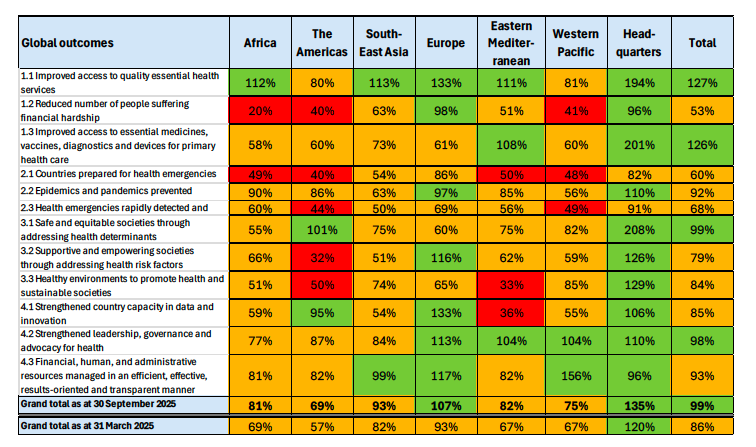
Now that the dust has settled on 2025, it’s possible from this report to get a more accurate assessment of WHO’s finances during 2024-25 and a better sense of what is in store in 2026-27. The 2024-25 program budget was $4968m and as of 30th September 2025 had been financed 102% ($5059m). While that may seem like good news – yaay, the WHO has received more money than it budgeted for – it disguises the fact that some of the WHO’s four strategic priorities (SP) were over funded, but with money that can’t be moved around to cover under-funded priorities. For example, SP1 (1bn more people benefitting from universal health coverage) was 118% funded while SP2 (1bn more people better protected from health emergencies) was only 71% funded. You can see the famous heatmap below, which shows (for example) that within SP2, WHO’s priority to help prepare countries in the Americas for health emergencies is only 40% financed. These are familiar and chronic ‘pockets of poverty’ that persist because of tightly earmarked (i.e. inflexible) voluntary funding from donors.
The United States withdrawal and $261m non receipt of its membership fees means the WHO is reliant on the 20% increase in assessed contributions agreed in May 2025.
The WHO’s Director General Dr Tedros planned for the 2024-25 biennium on the assumption that the United States would pay its assessed contributions on time in January 2024 and again in January 2025. It didn’t, hasn’t, and won’t pay these now, so the WHO has to somehow offset this $261m non receipt. It can’t just transfer the money from some other pot of money – the voluntary contributions it gets from State and non-State funders for example – because these funds are earmarked for specific things and so can’t be used for anything else. It’s not clear exactly how Tedros will manage this shortfall but the report states that the increase in membership fees “represent the most effective approach to offset the impact of the withdrawal of major donors” (p9). Of course, a significant amount of that 20% increase would have come from the US which now isn’t paying anything. Therefore it’s very important that Member States follow through and pay what they’ve agreed to pay.
The WHO will manage its reduced 2026-27 program budget by cost containment and slowing down implementation and utilisation of funds.
You’ll also recall that the approved base segment of the program budget for 2026-27 – $4.2bn – was significantly less than the $4.9bn amount agreed by WHO’s Program, Budget and Administration Committee (PBAC) at the beginning of 2025. How is the Secretariat going to manage that $700m reduction in budget? I’ve already mentioned the cost containment measures introduced last year (and see table 5 of A78/19 for a breakdown), but the report notes “a corresponding slowdown in program budget implementation” (p7) Perhaps that’s not surprising as downsizing the workforce is going to result in fewer projects being implemented. But the slowdown in implementation meant that utilisation of funds also reduced. The figure below shows that in March 2025 the Secretariat was anticipating that $4429m of the total program budget would be spent. That decreased by $96m to $4333m or 77% of the program budget in September, but by the end of 2025 the report projects that around 87% will be utilised. This level of utilisation of funds was carefully managed in 2025 so that by January 2026 – i.e. now – “WHO is fully prepared to operate effectively within the reduced Programme budget 2026–2027” (p7).
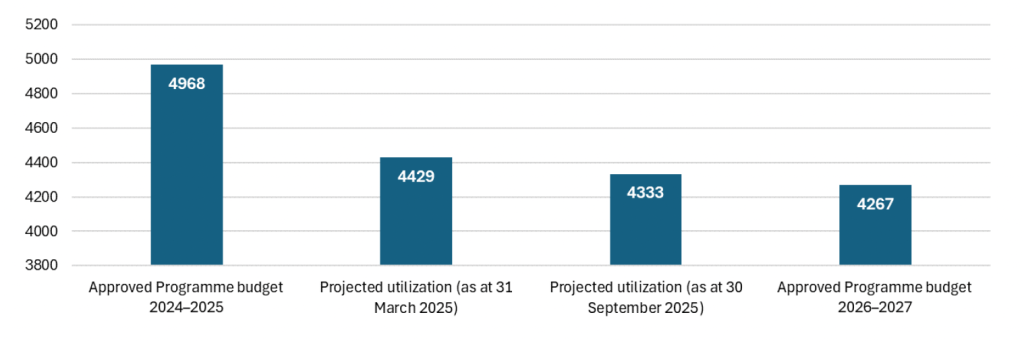
(US$ millions) at different points in time of the biennium.
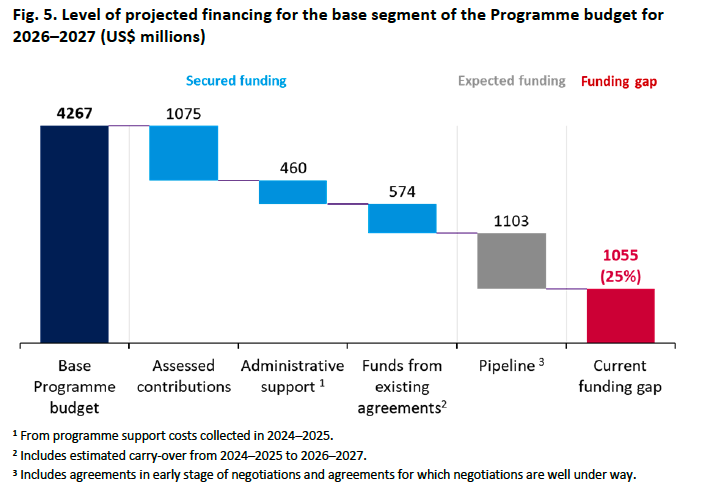
Funding levels for the 2026-27 program budget are projected at $3.2bn or 75%. This is not as good as it sounds!
Looking forward, the figure below shows projected financing for the base segment of the program budget 2026-27. Being 75% financed might seem like good news for this time in the funding cycle, but it’s not really. For one thing, as already noted, the 2026-27 budget is less than the 2024-25 budget – $700m less (meaning less money in total has to be accounted for). If the budgets were the same, we would be looking at 64% of the program budget funded. This is still more than what it was at the equivalent point in the 2024-25 funding cycle (i.e. January 2024) when it was 58%. But…this time around we have the benefit of the Investment Round (which didn’t exist for the 2024-25 budget) which has effectively front-loaded some of the 2026-27 budget. This is good news in terms of predictability, but as the report warns: “Given the highly constrained financial environment, closing the remaining funding gap for 2026–2027 will likely be more challenging than it has been in previous bienniums”.
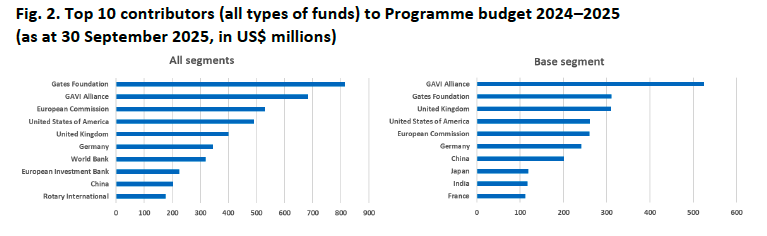
Just 4 of the top 10 donors to the 2024-25 program budget were individual Member States.
If you’ve made it this far, well done because I’ve left the best until last. Well, not really, but I did find it interesting and surprising to learn that with the US reneging on its membership fees, the GAVI Alliance and the Gates Foundation gave the most to the 2024-25 program budget. The figure below shows that GAVI gave the most to the base segment of the budget but the Gates Foundation gave the most overall. In fact, only 4 of the top 10 donors to the 2024-25 program budget (all segments) were individual Member States. The US was the most generous State actor, coming 4th across all segments of the budget, and the UK the most generous State donor to the base segment. China was 7th and India was 9th.
Ok, so that sums up my overview of this important report. I’m not sure how best to interpret it but I would make a couple of preliminary observations. First, the WHO is going to struggle to fully fund its 2026-27 program budget because much of the low-lying fruit has been picked. Second, Member States must honour their commitment to fund the extra 20% of assessed contributions. Third, we should be keeping a close eye on the funding of staff as there is still a significant gap to be filled. And fourth, reflecting on the support of GAVI in 2024-25, one has to wonder whether and to what extent the WHO can continue to rely on its support in the coming two years. Tedros must have breathed a huge sigh of relief to learn this week that the US Senate and HoR included GAVI funding in their foreign assistance appropriation bill for 2026. But one suspects that that is not the end of the story.
Andrew

And, indeed, it isn’t the end of the story as we learned on the 29th January that “The US government has frozen funds to GAVI, the global vaccine alliance, until it commits to a plan to phase out the preservative thimerosal from all the vaccines it distributes. The US demand, first reported by Reuters, is linked to the unproven belief held by US Health and Human Services (HHS) Secretary Robert F Kennedy Jr and allies that thimerosal, which contains mercury, is linked to autism”. Heavy sigh 🙁
It’s Tuesday 3rd February – Day 2 of the EB. It’ll be a few days before the Board gets to item 29.2 (EB158/45) and discusses the question of withdrawal fro the Organisation by the US and Argentina. Israel noted yesterday that Argentina has circulated a position paper to the Secretariat and MS, and that Israel will soon submit a draft resolution regarding this item. It feels like a coordinated response. We will have to wait to see the texts when they become publicly available.
It is reassuring to hear Tedros say that he thinks the WHO has “reached a position of stability” and that the shortfall for fully funding the 2026/27 PB is now only 15%. Of course, this is a significantly reduced budget, but it does suggest that the WHO could continue to function without the financial assistance of the US. The US won’t repay its dues, IMO. I thought last year that Trump might not leave, but he has and I don’t think he will return. So, we would have to wait for the election of a Democratic President for there to be any chance of the US returning to the Organisation. But the fees, well…
Legally, it is interesting to see how the US has focused on the ambiguity of when the payment of fees needs to be met, and not the two stipulations in EB158/45 (i.e. the notice period and the ‘shall be met in full’ clause). Some clever lawyer will have earned their bonus from that sad bit of pedantry. But I suppose it leaves the door open and, potentially, the US could still hold the fees back and use them as leverage at a later date? But I doubt it.
If there is a coordinated attack between a few Member States (Israel and Argentina, and the US behind the scenes), then it is a coordinated attack from two very minor players in terms of their funding to WHO, one of which is a pariah state in the eyes of many MS for the ongoing atrocities being committed in Gaza. But their financial contributions are insignificant. So, I guess the concern is more political than financial – will other MS wobble and follow suit? But is that a realistic concern?
I don’t think so. If I were Tedros, I would be talking to AFRO (Tanzania) and AMRO (Brazil) as these are regions who typically point out how inequitable the funding is to their regions. These countries’ support seems very important to me – they have to see the value in the Organisation. If there is going to be further balloons being sent up, then it would likely be from MS from these regions.
WHO needs to play it cool. It should not react to the false narrative that it is being ‘too political’. This is a deliberate framing designed to undermine legitimacy. Tedros should continue to emphasise the good things the WHO does, continually remind its MS what they have accomplished together (there were some highlights in 2025), and make the case for why the world needs the WHO. A really powerful public facing campaign is needed right now. Let the world know that it needs the WHO!
Under no circumstances can Tedros capitulate to the US or get into negotiations with it regarding its return. That would be a really bad decision and even be a trap – as it shows weakness. Tedros should stick to the regulations, keep the mandate as it is, and oversee as transparent as possible an election for his successor.