If the World Health Organisation’s only defender was Anders Nordström, then it would be fucked already. Thankfully, that’s not the case. Despite sounding like a Bond villain, Nordström is in fact – or was – a diplomat. Looking at his resume, it’s not entirely clear what he currently does but he is a former Acting and Assistant Director-General of WHO and a former Swedish Ambassador for Health. Imagine being identified by what you used to do (Andrew Harmer is a former Gardener for Lambeth Council). Oh, wait, he is a board member of the Alliance for Health Systems and Policy Research. So at least he has that going for him.
I suppose the point of it all is to establish one’s credentials. Nordström can write about the WHO because of what he used to do. He also floats in stellar company, as you can see from the list of collaborators in a recent Comment he wrote in the Lancet – A WHO worth fighting for: the case for focused, ambitious reform. They are so important that it took them almost 400 words to summarise all their accomplishments – sometimes, a list of email addresses just isn’t enough. Why, why, you might be asking, does it require eight people to write a Comment in the Lancet – can’t Nordström write it himself? Well, he probably did, maybe with a bit of help from Kazatchkine (who is the last author in the Comment in the Lancet) – just enough to get him the second best placing in the list of authors. The others are just the padding – Nkengasong, Piot, Robalo Correia e Silva, Alwan, Maciel, and Minghui – whose primary function is to add gravity to the position Nordström is taking. And to guarantee publication of a Comment in the Lancet, of course.
Note that Nordstrom is taking a position; he is not making an argument. There is nothing in his Comment in the Lancet that hasn’t been said by him and his cronies before (you will know them well: Nordström, Piot, Clarke, Rottingen, Kazatchkine, Kickbusch, Dybul, et al – the Geneva Gliterati), but he’s repeating it again in his Comment in the Lancet to keep the pressure up, to maintain the narrative he is trying to push so that his words become a reality. If you say something often enough, people will accept it just to shut you up. This is what power looks like – a bunch of pals using their collective mass to get their views down on paper and into policy. It happens. All. The. Time. If you don’t have guns and bombs, network instead and write a Comment in the Lancet.
But I can hear you at the back, “Bruce, Bruce, you pelican, we know that that’s how power works, stop rambling and clean the bloody drain!” I know, I know, I’m getting to that! For the TLDR crowd (i.e. all of you), let me pick out the key points and give you a one (maybe two) sentence reply to each. Ready?
- Refocus on core normative and scientific role.Thanks, Dad. WHO does this already and doesn’t need reminding to do it ad infinitum. But wait, what’s this? “WHO should help to set research priorities and norms but should not conduct research itself”. First off, The Welcome Trust won’t be very pleased to hear you say that – everyone knows that it’s the Trust’s job now to set global health research priorities. Second, WHO does research all the time – how else do you think its staff write their reports? Third, as you well know, WHO is working with academics all over the world to produce all manner of research – like on climate change and health. The idea that WHO should stop doing that is just dumb.
- Make governance more effective. OMFG, not this again. The WHO governs – get over it. What this is really about is FENSA and getting WHO to collaborate more with the private sector. Red flag, red flag!
- Reduce operational and delivery functions. “WHO should scale back operational roles, particularly in emergencies”. Wrong. Member States want WHO to do this kind of work. As I’ve argued previously, emergencies work is the heart and soul of WHO and it should do more not less of it. And don’t let the author’s caveat that “this should not be misinterpreted as a withdrawal from the emergency context” fool you. That’s exactly how it will be interpreted.
- Strengthen technical excellence and workforce. Read the room, FFS! WHO’s workforce has just taken a major kicking. You want to strengthen its technical excellence and workforce? Then stop firing people! And this made me laugh: “open and competitive recruitment for senior leadership is essential to building credibility and trust”. Lol – you guys! Comments in the Lancet like yours are interfering with the ‘open and competitive recruitment’ process, as you well know – you are deliberately closing the Overton window so that you get the DG you want.
- Improve country-level relevance. Thanks, the WHO knows that, and it’s on it.
- Prioritise financial independence. Thanks, the WHO knows – it REALLY knows that and – like point 1 – doesn’t need reminding. But – and see every single one of my previous 32 posts on this topic – it’s not just about financial independence.
What Nordström is forgetting to mention is that Member States don’t seem to give a fuck about the WHO – at least not enough to fund it adequately. Here’s an image from the just-published Audited Financial Statement for 2025.
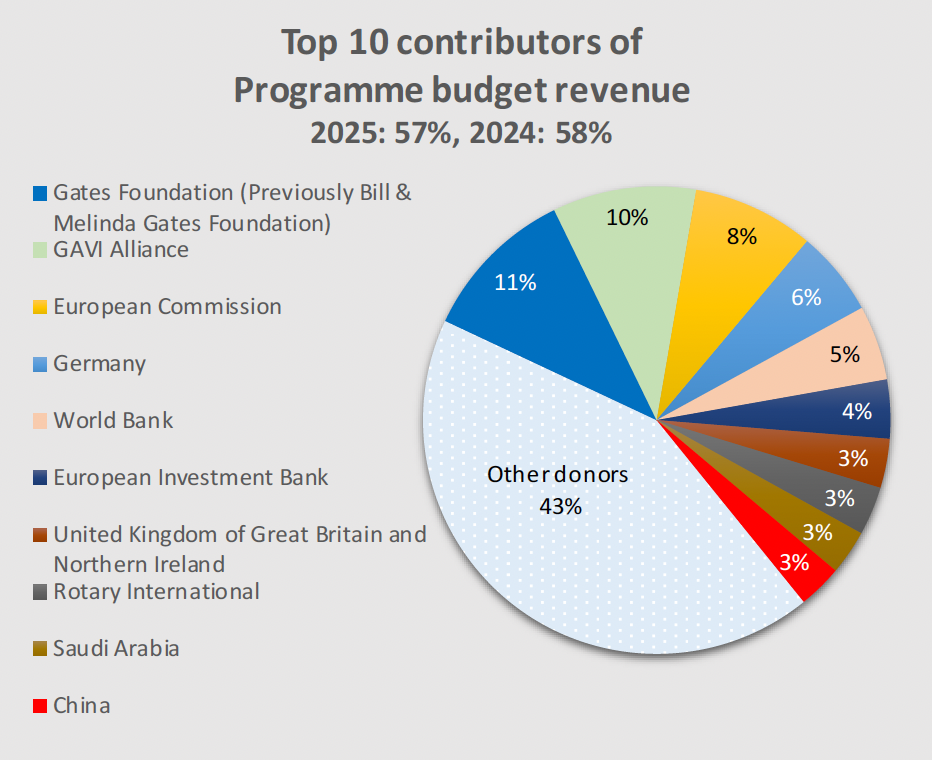
Notice anything peculiar? Yes, correct, only one Member State (Germany) contributed more to the WHO in 2025 than Rotary International! What the fuck is wrong with you, Member States? Do you want a WHO or don’t you? The reason why we have to read tedious Comments in the Lancet from grey commentators like Nordström is because you won’t fund the Organisation to do the work it needs to do – and should be doing! No research? That’s because you won’t fund it to do research. No emergencies work? That’s because you won’t fund it to do emergencies work. You want technically skilled and valued staff – then pay up so that the Secretariat doesn’t have to sack them all to cover your funding shortfalls.
The fact that Nordström et al focus entirely on financial independence is predictable, and irritating. I wrote a whole paper on this once. I agree that relying on a small number of donors is unsustainable – after all, the Organisation’s current number one donor is headed by someone who associated with someone who turned out to be a sex trafficker. That’s not a good look for WHO and I’d be expecting the next DG to address that. Hey, Nordström, you could add it to your review of FENSA. No funding from NSAs whose leads are in any way connected to Jeffrey Epstein. It hasn’t been a total disaster (yet) that the WHO’s historically top donor – the United States – has walked off. It may yet be, of course. But the correct response from Member States is to contribute more through flexible voluntary contributions. But that’s not what they are doing.They’re doing the opposite of that, in fact. Not only are they contributing less voluntary contributions year on year (in 2025, VCs from Member States were down by $175m after offsetting), they’re contributing less of the flexible (core) VCs (down $104m in 2025).
Much like capitalism and the end of the world, currently it seems easier to imagine the end of WHO than imagine Member States paying more to save it.
Andrew

I would like to emphasize a key issue within WHO which, if left unaddressed, makes the organization hardly worth saving: the recruitment of its workforce.
Yes, WHO’s added value should -in principle- be its staff.
Sadly, a large percentage of WHO’s staff is nepotistically recruited, facilitated by easily manipulated HR procedures often instigated by disproportionally powerful senior managers, such as WHO Representatives, Regional Directors, and their ‘loyal allies’ with job titles that include words like ‘director’, ‘head’, ‘lead’ or ‘advisor’.
Sadly, the great majority of the nepotistically recruited are incompetent, unqualified, and uninterested: if their resumes do not meet the minimum requirements for the post, these can be conveniently adjusted to justify the selection of the ‘preferred candidate’. Too many (mostly international) WHO staff only care about the status and the salary that comes with the position: salaries are high and make working for a UN agency extremely attractive, not to mention all the additional perks like paid (international) travel in business class and 5-star hotels, (international) school fees for children, loans, good health insurance, etc.
Sadly, none of these nepotistically recruited people seem to have lost their jobs in the recent waves of firings: on the contrary, many seem to have been promoted, helped by the lack of competition resulting from the firing of those that were competent.
As one nepotistically recruited staff member usually continues with the practice of nepotistic recruitments, WHO is now full of incompetent people, with many of the good, competent ones let go of because of the funding crisis. This is creating a highly toxic, unhealthy workplace, contrary to one of WHO’s own policies. In-country donors see this, and are understandably not eager to continue to support a workforce that has been hired under questionable circumstances, unable or unwilling to do even the minimum of what can be expected from someone working for THE UN health agency. THIS is one of the most important reasons why donors are not giving WHO more money.
Yes, WHO should be more operational in emergencies, especially in a world plagued by wars and impunity. BUT:
WITHOUT the current incompetent emergency team leads who keep their teams busy with unnecessary meetings and tedious administrative approval processes using a non-functional financial system from over 20 years old.
WITHOUT incompetent WHO Representatives that lack any prior emergency experience but have been appointed to countries affected by complex, protracted crises: a WHO Representative in Myanmar who collaborates with the military regime that bombards hospitals run by opposition groups, ‘just because that is what WHO does: support the Ministry of Health’. Or a WHO Representative in South Sudan who denies the existence of a humanitarian crisis in the country, and ‘guides’ his nepotistically recruited staff to ‘only focus on developmental, longer-term health investments’, as people die from preventable diseases and lack of access to even a health post.
WITHOUT the elected leadership that is the root cause of WHO’s nepotistic recruitments. A Director General who -when minister of health in his country of origin- mandated family planning measures on one of his ‘enemy’ ethnic groups (Amhara) to reduce their population numbers. A Regional Director whose mother -a convicted war criminal- paid the ministers of health in the Southeast Asia region for their votes, in return for political favors.
What can be expected from such ‘leaders’ if the respective processes used to elect them are highly politicized? How can WHO still be considered a purely technical agency, if its ‘leaders’ are elected based on politically motivated promises? How can WHO be impartial, independent and neutral, with politically elected ‘leaders’ who then refuse to engage in countries or with groups that are not politically aligned with those that voted for them? How many people have died as a result of conflicts or other emergencies because the WHO ‘leadership’ delayed crucial decision-making in situations that were not considered ‘politically relevant’?
With my response to your article, I would like to advocate for a WHO WITHOUT elected leadership, where directors, representatives, and managers are appointed based on proven competence, applying functional systems that do not depend on individuals’ personal preferences, either for the recruitment of staff, or any type of decision to enable WHO to comply with its mandate: to promote health, keep the world safe, and serve the vulnerable.
What I find most strange about these kind of comments (and there are many – see, for example, Tang and Merson’s Comment in the Lancet a couple of weeks before Nordstrom’s) is that they never acknowledge the recent and ongoing efforts within the WHO to reform governance structures and systems, or identify efficiencies and contain costs. These initiatives have all been requested and approved by member states, and the Secretariat has been – year on year – implementing them and, as requested, updating member states on progress. You can read about one such reform workflow in document A79/16 Financing, implementation and performance framework of the Programme budget 2026–2027: Reporting on operational efficiencies which reports cost and time savings of $138m for 2025. This process has been going on for years, and the reason why it’s happening is because of the failure by member states to adequately fund the Organisation. Reading Comments in the Lancet by Nordstrom or Tang give the impression that the Secretariat is doing nothing to reform the Organisation when, in fact, the Secretariat is constantly reforming its governance arrangements. And, to repeat, it is doing all of this because its member states have asked it to. In other words, there is a clear democratic process of decision-making. Maybe it’s because I work in an admin-heavy environment – where I spend months implementing new systems only to have them regularly undermined by some new initiative or restructure or whatever – that I want to scream when I read some random academic saying ‘oh, you know what, let’s get rid of WHO’s regional offices’ or ‘what about those country offices – I know, let’s have some partially funded and some have more funding’ or ‘I think we need to reduce more staff and eliminate some programs – yes, yes, I’m sure WHO is doing something about all of that, but I don’t need to know about the details – just get it done (now, preferably)’. Commentaries like these typically show zero understanding of the work that goes on in WHO every day, and little to no respect for or humanity towards the staff doing the work. And have you noticed how it’s always about the Secretariat never member states? Yet THEY are the ones who should be under scrutiny. WHO is just trying to pick up the pieces of THEIR collective failure.